 Add to Chrome
 Add to Firefox
 Add to Edge
TriLens: Per-Layer Logit-Lens Entropy for White-Box Hallucination Detection
May 31, 2026
When a language model hallucinates, the final answer is wrong, but the mistake is not necessarily invisible inside the model. Different internal pathways may remain uncertain, disagree in how quickly they sharpen, or commit to competing continuations before the output is produced. We introduce TriLens, a white-box detector that turns this intuition into a compact representation: at every layer, it reads the multi-head self-attention output, the feed-forward output, and the residual stream through the model's own logit lens, then records only the entropy of each readout. The resulting 3L-dimensional trajectory describes how certainty forms across depth and across modules, without storing high-dimensional hidden states or sampling multiple generations. This simple signal yields a strong detector across instruction-tuned LLMs and QA benchmarks, and our analyses show that the three module-wise entropy trajectories provide complementary evidence. TriLens suggests that hallucination detection can benefit from tracking how internal computation settles, not only what the final layer predicts.

The MiniMax-M2 Series: Mini Activations Unleashing Max Real-World Intelligence
May 26, 2026We introduce the MiniMax-M2 series, a family of Mixture-of-Experts language models built around the principle that mini activations can unleash maximum real-world intelligence. The flagship M2 contains 229.9B total parameters with only 9.8B activated per token. Designed end-to-end for agentic deployment, the M2 series rests on three components: (i) agent-driven data pipelines producing large-scale, verifiable trajectories across agentic coding and agentic cowork, each grounded in an executable workspace and an artifact-aligned reward; (ii) Forge, a scalable agent-native RL system that adapts to long-horizon agent trajectories, paired with windowed-FIFO scheduling, prefix-tree merging, inference optimization, and a clean training-inference-agent decoupling that supports both white-box and black-box agents; (iii) the latest M2.7 checkpoint takes an early step toward self-evolution -- autonomously debugging training runs and modifying its own scaffold. Across M2 through M2.7, this combination translates a mini-activation footprint into frontier-tier performance on agentic coding, deep search, office-task, and reasoning benchmarks.
Agent Q-Mix: Selecting the Right Action for LLM Multi-Agent Systems through Reinforcement Learning
Apr 01, 2026Large Language Models (LLMs) have shown remarkable performance in completing various tasks. However, solving complex problems often requires the coordination of multiple agents, raising a fundamental question: how to effectively select and interconnect these agents. In this paper, we propose \textbf{Agent Q-Mix}, a reinforcement learning framework that reformulates topology selection as a cooperative Multi-Agent Reinforcement Learning (MARL) problem. Our method learns decentralized communication decisions using QMIX value factorization, where each agent selects from a set of communication actions that jointly induce a round-wise communication graph. At its core, Agent Q-Mix combines a topology-aware GNN encoder, GRU memory, and per-agent Q-heads under a Centralized Training with Decentralized Execution (CTDE) paradigm. The framework optimizes a reward function that balances task accuracy with token cost. Across seven core benchmarks in coding, reasoning, and mathematics, Agent Q-Mix achieves the highest average accuracy compared to existing methods while demonstrating superior token efficiency and robustness against agent failure. Notably, on the challenging Humanity's Last Exam (HLE) using Gemini-3.1-Flash-Lite as a backbone, Agent Q-Mix achieves 20.8\% accuracy, outperforming Microsoft Agent Framework (19.2\%) and LangGraph (19.2\%), followed by AutoGen and Lobster by OpenClaw. These results underscore the effectiveness of learned, decentralized topology optimization in pushing the boundaries of multi-agent reasoning.
veScale-FSDP: Flexible and High-Performance FSDP at Scale
Feb 25, 2026Fully Sharded Data Parallel (FSDP), also known as ZeRO, is widely used for training large-scale models, featuring its flexibility and minimal intrusion on model code. However, current FSDP systems struggle with structure-aware training methods (e.g., block-wise quantized training) and with non-element-wise optimizers (e.g., Shampoo and Muon) used in cutting-edge models (e.g., Gemini, Kimi K2). FSDP's fixed element- or row-wise sharding formats conflict with the block-structured computations. In addition, today's implementations fall short in communication and memory efficiency, limiting scaling to tens of thousands of GPUs. We introduce veScale-FSDP, a redesigned FSDP system that couples a flexible sharding format, RaggedShard, with a structure-aware planning algorithm to deliver both flexibility and performance at scale. veScale-FSDP natively supports efficient data placement required by FSDP, empowering block-wise quantization and non-element-wise optimizers. As a result, veScale-FSDP achieves 5~66% higher throughput and 16~30% lower memory usage than existing FSDP systems, while scaling efficiently to tens of thousands of GPUs.
ExpertWeaver: Unlocking the Inherent MoE in Dense LLMs with GLU Activation Patterns
Feb 17, 2026Mixture-of-Experts (MoE) effectively scales model capacity while preserving computational efficiency through sparse expert activation. However, training high-quality MoEs from scratch is prohibitively expensive. A promising alternative is to convert pretrained dense models into sparse MoEs. Existing dense-to-MoE methods fall into two categories: \textbf{dynamic structural pruning} that converts dense models into MoE architectures with moderate sparsity to balance performance and inference efficiency, and \textbf{downcycling} approaches that use pretrained dense models to initialize highly sparse MoE architectures. However, existing methods break the intrinsic activation patterns within dense models, leading to suboptimal expert construction. In this work, we argue that the Gated Linear Unit (GLU) mechanism provides a natural blueprint for dense-to-MoE conversion. We show that the fine-grained neural-wise activation patterns of GLU reveal a coarse-grained structure, uncovering an inherent MoE architecture composed of consistently activated universal neurons and dynamically activated specialized neurons. Leveraging this discovery, we introduce ExpertWeaver, a training-free framework that partitions neurons according to their activation patterns and constructs shared experts and specialized routed experts with layer-adaptive configurations. Our experiments demonstrate that ExpertWeaver significantly outperforms existing methods, both as a training-free dynamic structural pruning technique and as a downcycling strategy for superior MoE initialization.
Train Less, Learn More: Adaptive Efficient Rollout Optimization for Group-Based Reinforcement Learning
Feb 15, 2026Reinforcement learning (RL) plays a central role in large language model (LLM) post-training. Among existing approaches, Group Relative Policy Optimization (GRPO) is widely used, especially for RL with verifiable rewards (RLVR) fine-tuning. In GRPO, each query prompts the LLM to generate a group of rollouts with a fixed group size $N$. When all rollouts in a group share the same outcome, either all correct or all incorrect, the group-normalized advantages become zero, yielding no gradient signal and wasting fine-tuning compute. We introduce Adaptive Efficient Rollout Optimization (AERO), an enhancement of GRPO. AERO uses an adaptive rollout strategy, applies selective rejection to strategically prune rollouts, and maintains a Bayesian posterior to prevent zero-advantage dead zones. Across three model configurations (Qwen2.5-Math-1.5B, Qwen2.5-7B, and Qwen2.5-7B-Instruct), AERO improves compute efficiency without sacrificing performance. Under the same total rollout budget, AERO reduces total training compute by about 48% while shortening wall-clock time per step by about 45% on average. Despite the substantial reduction in compute, AERO matches or improves Pass@8 and Avg@8 over GRPO, demonstrating a practical, scalable, and compute-efficient strategy for RL-based LLM alignment.
AI-Native 6G Physical Layer with Cross-Module Optimization and Cooperative Control Agents
Jan 07, 2026In this article, a framework of AI-native cross-module optimized physical layer with cooperative control agents is proposed, which involves optimization across global AI/ML modules of the physical layer with innovative design of multiple enhancement mechanisms and control strategies. Specifically, it achieves simultaneous optimization across global modules of uplink AI/ML-based joint source-channel coding with modulation, and downlink AI/ML-based modulation with precoding and corresponding data detection, reducing traditional inter-module information barriers to facilitate end-to-end optimization toward global objectives. Moreover, multiple enhancement mechanisms are also proposed, including i) an AI/ML-based cross-layer modulation approach with theoretical analysis for downlink transmission that breaks the isolation of inter-layer features to expand the solution space for determining improved constellation, ii) a utility-oriented precoder construction method that shifts the role of the AI/ML-based CSI feedback decoder from recovering the original CSI to directly generating precoding matrices aiming to improve end-to-end performance, and iii) incorporating modulation into AI/ML-based CSI feedback to bypass bit-level bottlenecks that introduce quantization errors, non-differentiable gradients, and limitations in constellation solution spaces. Furthermore, AI/ML based control agents for optimized transmission schemes are proposed that leverage AI/ML to perform model switching according to channel state, thereby enabling integrated control for global throughput optimization. Finally, simulation results demonstrate the superiority of the proposed solutions in terms of BLER and throughput. These extensive simulations employ more practical assumptions that are aligned with the requirements of the 3GPP, which hopefully provides valuable insights for future standardization discussions.
Virtual Width Networks
Nov 17, 2025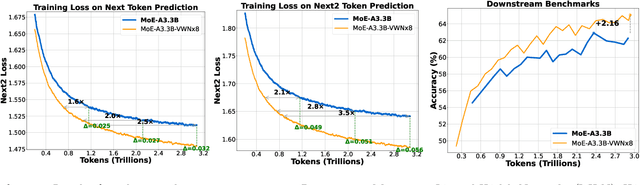
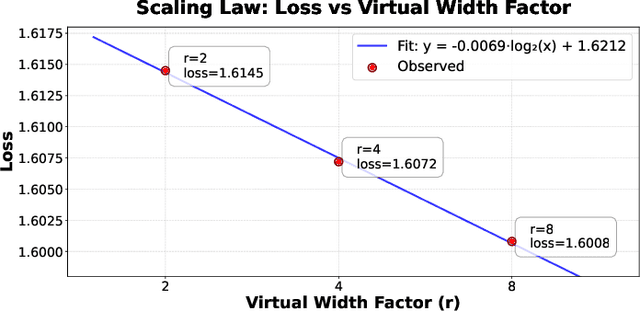
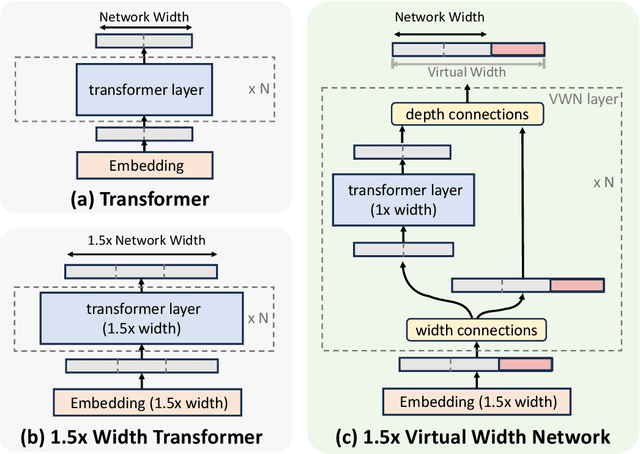
We introduce Virtual Width Networks (VWN), a framework that delivers the benefits of wider representations without incurring the quadratic cost of increasing the hidden size. VWN decouples representational width from backbone width, expanding the embedding space while keeping backbone compute nearly constant. In our large-scale experiment, an 8-times expansion accelerates optimization by over 2 times for next-token and 3 times for next-2-token prediction. The advantage amplifies over training as both the loss gap grows and the convergence-speedup ratio increases, showing that VWN is not only token-efficient but also increasingly effective with scale. Moreover, we identify an approximately log-linear scaling relation between virtual width and loss reduction, offering an initial empirical basis and motivation for exploring virtual-width scaling as a new dimension of large-model efficiency.
Doc-Researcher: A Unified System for Multimodal Document Parsing and Deep Research
Oct 24, 2025Deep Research systems have revolutionized how LLMs solve complex questions through iterative reasoning and evidence gathering. However, current systems remain fundamentally constrained to textual web data, overlooking the vast knowledge embedded in multimodal documents Processing such documents demands sophisticated parsing to preserve visual semantics (figures, tables, charts, and equations), intelligent chunking to maintain structural coherence, and adaptive retrieval across modalities, which are capabilities absent in existing systems. In response, we present Doc-Researcher, a unified system that bridges this gap through three integrated components: (i) deep multimodal parsing that preserves layout structure and visual semantics while creating multi-granular representations from chunk to document level, (ii) systematic retrieval architecture supporting text-only, vision-only, and hybrid paradigms with dynamic granularity selection, and (iii) iterative multi-agent workflows that decompose complex queries, progressively accumulate evidence, and synthesize comprehensive answers across documents and modalities. To enable rigorous evaluation, we introduce M4DocBench, the first benchmark for Multi-modal, Multi-hop, Multi-document, and Multi-turn deep research. Featuring 158 expert-annotated questions with complete evidence chains across 304 documents, M4DocBench tests capabilities that existing benchmarks cannot assess. Experiments demonstrate that Doc-Researcher achieves 50.6% accuracy, 3.4xbetter than state-of-the-art baselines, validating that effective document research requires not just better retrieval, but fundamentally deep parsing that preserve multimodal integrity and support iterative research. Our work establishes a new paradigm for conducting deep research on multimodal document collections.
NeuroAda: Activating Each Neuron's Potential for Parameter-Efficient Fine-Tuning
Oct 21, 2025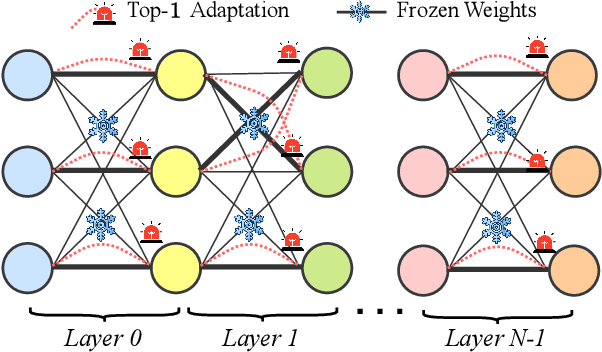
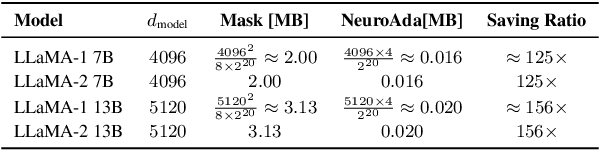
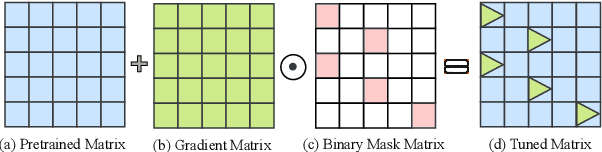
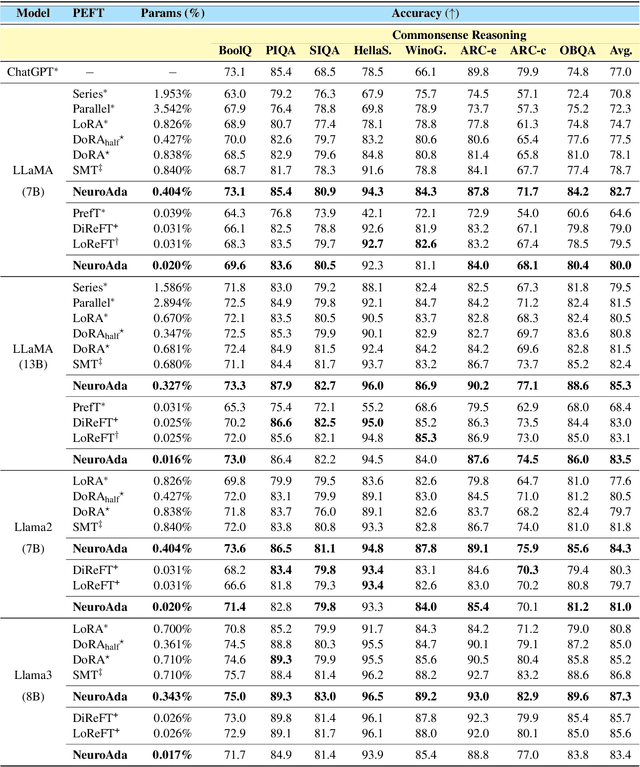
Existing parameter-efficient fine-tuning (PEFT) methods primarily fall into two categories: addition-based and selective in-situ adaptation. The former, such as LoRA, introduce additional modules to adapt the model to downstream tasks, offering strong memory efficiency. However, their representational capacity is often limited, making them less suitable for fine-grained adaptation. In contrast, the latter directly fine-tunes a carefully chosen subset of the original model parameters, allowing for more precise and effective adaptation, but at the cost of significantly increased memory consumption. To reconcile this trade-off, we propose NeuroAda, a novel PEFT method that enables fine-grained model finetuning while maintaining high memory efficiency. Our approach first identifies important parameters (i.e., connections within the network) as in selective adaptation, and then introduces bypass connections for these selected parameters. During finetuning, only the bypass connections are updated, leaving the original model parameters frozen. Empirical results on 23+ tasks spanning both natural language generation and understanding demonstrate that NeuroAda achieves state-of-the-art performance with as little as $\leq \textbf{0.02}\%$ trainable parameters, while reducing CUDA memory usage by up to 60%. We release our code here: https://github.com/FightingFighting/NeuroAda.git.